Math Written Exam Demo
Below, you can find sample math written exam based on the selected program.
We recommend reading key terms in the Glossary first.
Below, you can find sample math written exam based on the selected program.
We recommend reading key terms in the Glossary first.
The application form for the Technology Leaders of the Future program will open in November. Applications are currently closed.
Please read the short version below (1 minute).
Exam in 6 steps
You need:
Question 1.
a) Prove that if $p > 3$ is prime, then $p^2 - 1$ is divisible by $3$.
b) Prove that if $p > 3$ is prime, then $p^2 - 1$ is divisible by $24$.
c) Can the sum of the squares of three consecutive primes, each greater than $3$, be prime? Justify your answer.
Question 2. Prove that for any real numbers $a$, $b$, and $c$,
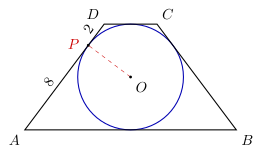
Question 3. An isosceles trapezoid is circumscribed about a circle. The point of tangency of the circle with a leg divides this leg into segments of lengths $2$ and $8$. Find the area of the trapezoid.
Question 4. Given that
a) Find $x^2 + \frac{1}{x^2}$.
b) Find $x^3 + \frac{1}{x^3}$.
c) Find $x^5 + \frac{1}{x^5}$.
Question 5.
a) In how many ways can a person put on a matching sock and shoe on each foot (left and right), given that on each foot the sock must be put on before the shoe?
b) Spiffy the Spider has 8 legs, each of a different colour. For each leg, he has one sock and one shoe of the matching colour. In how many ways can he put on all his socks and shoes if, on each leg, the sock must be put on before the shoe?
Question 6. Solve the system of equations in real numbers:
Question 7. A pedestrian left point $A$ for point $B$. Two hours later, a cyclist left $A$ after him, and another $30$ minutes later, a motorcyclist left $A$. All three moved uniformly without stopping. At some moment after the motorcyclist's departure, it turned out that by that time all three had covered the same fraction of the route from $A$ to $B$.
a) On the coordinate plane $(t; s)$, where $t$ is time (in hours) and $s$ is the fraction of the route completed, draw the graphs of the pedestrian, cyclist, and motorcyclist. Let $t = 0$ correspond to the moment the pedestrian left $A$.
b) Hence, or otherwise, find how many minutes earlier than the pedestrian the cyclist arrived at $B$, given that the pedestrian arrived at $B$ one hour later than the motorcyclist.
Question 8.
a) Find the value of the parameter $a$ such that the equation
has a root equal to $-2$.
b) For the value of $a$ found in part (a), find all roots of the equation.
Question 9. The integers from $1$ to $10$ are written on a blackboard. In one move, one may erase any two numbers $a$ and $b$, and replace them with their difference $|a - b|$. The process continues until only one number remains.
a) Determine whether the sum of all numbers on the board changes parity after each move.
b) What is the least possible value of the final remaining number?
Question 10. Two fixed points $A$ and $B$ and a point $M$ are given in the plane.
a) Introduce a Cartesian coordinate system such that points $A$ and $B$ have coordinates $(-a, 0)$ and $(a, 0)$ respectively ($a > 0$), and point $M$ has coordinates $(x, y)$. Find the lengths of the segments $AM$ and $BM$ in terms of $x$, $y$, and $a$.
b) Find the relation between the coordinates $(x, y)$ of point $M$ if
where $k > 0$ is a given constant.
c) Determine the locus of all such points $M$ (consider the cases $k = 1$ and $k \neq 1$ separately).
Question 1.
a) Is $2^{2026}-1$ a prime number?
b) Prove that if $2^n-1$ (where $n$ is a positive integer) is prime, then $n$ is prime.
c) Is the converse statement true?
Question 2. Solve the system of equations:
Question 3. On the sides of a triangle of area $1$, squares are constructed externally, and their outer vertices are connected by red segments as shown in the figure.
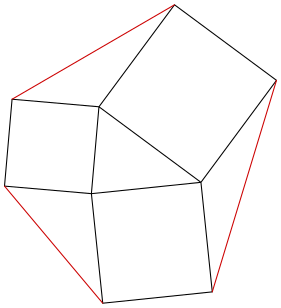
Prove that the three red segments can form a triangle of area $3$.
Question 4. Consider the expression
a) Prove that if $x = -y$, then the expression equals $0$.
b) Hence, or otherwise, factor completely the expression.
Question 5. Three boys, who have one bicycle, need to reach a camp in the shortest possible time. All three of them start at the same time, and since there is only room for two on the bicycle, the third boy must first walk. The cyclist drives one of his friends for a while, then that friend continues on foot, and the cyclist returns to the third boy and they all arrive at the camp at the same moment. Find the average speed of the three boys, given that all of them walk at the same speed of $4 \text{ km/h}$, and the bicycle speed is $20 \text{ km/h}$.
Question 6. For which values of the parameter $a$ does the solution set of the inequality
form a closed interval?
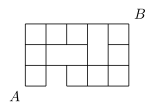
Question 7. In the grid shown below (with some missing edges), how many paths are there from $A$ to $B$ using only steps one unit up or one unit to the right, given that a path cannot traverse a missing edge?
Question 8. Solve the equation:
Question 9. A group of psychologists has developed a test that assigns each person who takes it a score — a positive integer $Q$ — which serves as an indicator of their intellectual abilities (the higher the $Q$, the greater the abilities). The rating of a country is defined as the arithmetic mean of the $Q$ scores of all its residents.
a) A group of citizens from country $A$ emigrated to country $B$. Could the ratings of both countries have increased as a result?
b) Following this, a group of citizens from country $B$ (which may include former emigrants from $A$) emigrated to country $A$. Is it possible that the ratings of both countries increased again?
c) A group of citizens from country $A$ emigrated to country $B$, and after it a group of citizens from country $B$ emigrated to country $C$. As a result, the ratings of each country became higher than their initial values. After this, the direction of the migration flows reversed: some residents from $C$ moved to $B$, and after it some residents from $B$ moved to $A$. It turned out that as a result, the ratings of all countries increased again (compared to their values after the first migration wave but before the start of the second). Is this possible (if yes, provide an example; if no, explain why)? Assume that during the time under consideration, the $Q$ scores of the citizens remained constant, and no one was born or died.
Question 10. For a point $P$ and a circle $\omega$ with centre $Q$ and radius $r$, define the number $\Pi_\omega$ as follows.
If $P$ is not on $\omega$, draw a line through $P$ that intersects $\omega$ at points $A$ and $B$. Then set
where the value is taken positive when $P$ is outside the circle and negative when $P$ is inside. If $P$ lies on $\omega$, we set $\Pi_\omega = 0$.
a) Prove that for any point $P$ and any circle $\omega$ with centre $Q$ and radius $r$,
Now consider two non-concentric circles: $\omega_1$ with centre $O$ and radius $R$, and $\omega_2$ with centre $O'$ and radius $R'$.
b) Introduce a coordinate system with origin at $O$, $x$-axis along $OO'$. Let $O(0;0)$, $O'(d;0)$, where $d = OO' > 0$. For a point $P(x;y)$, write down the expressions for $PO^2$ and $PO'^2$.
c) Using the result of part (a), write the equation of the locus of points $P$ for which $\Pi_{\omega_1} = \Pi_{\omega_2}$. Simplify this equation and express the coordinate $x$ in terms of $R$, $R'$, and $d$.
d) Prove that the locus of points $P$ satisfying $\Pi_{\omega_1} = \Pi_{\omega_2}$ is a straight line perpendicular to the line of centres $OO'$.