Пример письменного экзамена

Ниже вы можете посмотреть примеры письменного экзамена в зависимости от программы.
Также рекомендуем изучить список математических терминов в Glossary.

Формат письменного экзамена

Пожалуйста, сначала прочитайте короткую версию ниже.

Экзамен в 6 шагах

  1. Установите приложение прокторинга.
  2. Начните экзамен по экзаменационной ссылке в назначенное время.
  3. Решайте задачи на бумаге (120 минут).
  4. Получите QR-код.
  5. Сфотографируйте решения.
  6. Загрузите фотографии и завершите экзамен.

Вам понадобится:

  • компьютер с камерой и микрофоном;
  • смартфон с камерой;
  • стабильный интернет.

Подробнее

До экзамена
  • На почту придут две ссылки: ознакомительная и экзаменационная.
  • Пройдите все шаги по ознакомительной ссылке заранее.
  • Тренируйтесь на том же устройстве и в той же сети, где будете сдавать экзамен.
  • Заранее установите Constructor Proctor и проверьте камеру/микрофон.
  • Дату и время экзамена сообщим кандидатам заранее.
Начало экзамена
  • После старта откроется запуск Constructor Proctor и проверка устройства.
  • После проверки запускается защищённый полноэкранный браузер.
Во время решения
  • На решение задач отведено 120 минут.
  • Задачи можно решать в любом порядке.
  • Нужны развёрнутые письменные решения на английском языке.
  • Калькуляторы, помощь других людей, генеративные модели и переходы по вкладкам запрещены.
  • Смартфоном во время решения пользоваться нельзя.
Загрузка решений
  • После окончания времени (или по кнопке «закончить») вы получите QR-код.
  • На фотографирование и загрузку решений даётся 10 минут.
  • Сканируйте QR-код смартфоном и откройте страницу загрузки.
  • Сфотографируйте все листы с решениями и загрузите их.
  • После загрузки завершите экзамен в приложении прокторинга.
Технические требования
  • Ноутбук или компьютер: Windows 10+ или macOS 11+ (Big Sur).
  • Нужны рабочие камера, микрофон и стабильный интернет (5 Mbit/s).
  • Также нужен смартфон с камерой, интернетом и актуальным браузером.
  • Нужна программа для считывания QR-кодов и умение ей пользоваться.
  • Linux, Chromebook, iPad, планшеты и смартфоны в роли основного устройства не поддерживаются.
Полный регламент экзамена

Устройства и ПО

  • Для участия в письменном экзамене потребуется ноутбук или компьютер (с Windows 10+ или macOS 11+ (Big Sur)) с работающими камерой и микрофоном, устойчивое подключение к интернету (2Mbit/s).
  • Также потребуется смартфон с работающей камерой, подключённый к интернету, с актуальным браузером. А также программа для считывания QR-кодов и умение ей пользоваться.
  • Подробные требования к компьютеру:
    Показать подробности
    • Операционная система: Windows 10+ или macOS 11+ (Big Sur). Windows S mode, хромбуки, Linux, iPads, планшеты и смартфоны не поддерживаются.
    • Hardware: 1 GB дискового пространства (для приложения прокторинга и кеша записи), 2 GB оперативной памяти, 2.0GHz CPU процессор.
    • Интернет-соединение: 2Mbit/s на скачивание и на загрузку.
    • Работающая камера (можно внешняя) и микрофон с актуальными драйверами (выпущенными в течение последних 5 лет).
  • Для работы системы прокторинга Constructor Proctor необходимо заранее установить приложение.
  • Ссылка на руководство для Windows: Constructor Proctor Learner Guide и для MacOS: Constructor Proctor Learner Guide .
  • Подробная инструкция по установке:
    Показать подробности
    • Windows
      • Откройте руководство по ссылке Constructor Proctor Learner Guide .
      • Откройте загруженный файл после завершения скачивания.
      • Приложение Constructor Proctor выполнит краткую установку и запустится автоматически.
      • Если вы уже использовали Constructor Proctor ранее, оно запустится автоматически, загрузит и установит обновления перед началом проверки системы.
    • Mac
      • Откройте руководство по ссылке Constructor Proctor Learner Guide .
      • Откройте загруженный файл после завершения скачивания.
      • В открывшемся окне перетащите приложение Constructor Proctor в папку Applications.
      • Откройте папку Applications и запустите приложение Constructor Proctor.
      • Приложение выполнит краткую установку и запустится автоматически.
      • Если вы уже использовали Constructor Proctor ранее, оно запустится автоматически, загрузит и установит обновления перед началом проверки системы.

Задачи и решения

  • Примеры задач экзамена вы можете увидеть ниже.
  • Задачи будут даны на английском языке.
  • Потребуются развёрнутые решения задач, записанные на бумаге на английском языке.
  • Правильные ответы без пояснений получат 0 баллов.
  • За неполные решения или мелкие ошибки будут выставляться частичные баллы.
  • Правильные чертежи для геометрических задач настоятельно рекомендуются.
  • Для успешного прохождения не требуется решить все задачи, но постарайтесь решить как можно больше.
  • Задачи можно решать в любом порядке.
  • Во время экзамена разрешается использовать ручку, карандаш и бумагу.
  • Запрещено использовать калькулятор, помощь других людей, генеративные модели (ChatGPT, DeepSeek и т. п.), а также переключаться на другие вкладки браузера.
  • В случае необходимости, можно попросить помощь с переводом термина или задать вопрос по задаче через чат с поддержкой (кнопка «?» после каждой задачи).

Этапы экзамена

  • По электронной почте вам придёт письмо с двумя ссылками: ссылкой для ознакомления с интерфейсом, и ссылка на экзамен.
  • Настоятельно рекомендуем пройти все шаги экзамена по ознакомительной ссылке, чтобы заранее установить и настроить приложение и убедиться, что нет никаких технических проблем с оборудованием.
  • Дату, время и порядок начала экзамена сообщим кандидатам заранее.
  • После начала экзамена вы попадёте на страницу запуска приложения прокторинга Constructor Proctor (приложение уже должно быть установлено к этому моменту).
  • После запуска приложения Constructor Proctor приложение проверит ваше устройство: наличие камеры, микрофона, отсутствие второго монитора, интернет-соединение и т.п.
  • Затем приложение сделает вашу фотографию.
  • После прохождения всех проверок, будет запущен защищённый браузер с условиями задач. Браузер будет развёрнут на полный экран, свернуть его можно будет только после окончания экзамена. Переключаться между вкладками, переходить на другие страницы, делать скриншоты запрещено.
  • Пользоваться смартфоном во время решения задач запрещено.
  • Примеры задач можно посмотреть ниже. Интерфейс с задачами будет совпадать с интерфейсом тестирования.
  • После окончания 120 минут на запись решений (или после нажатия на кнопку «закончить») вы получите QR-код с ссылкой на страницу загрузки решений.
  • Дальше нужно будет считать смартфоном QR-код с ссылкой на страницу загрузки решений. Открыть её смартфоном, сделать и загрузить фотографии всех ваших решений.
  • После этого завершить экзамен в приложении прокторинга.
  • В случае технических сбоев, потери интернет соединения и т.п., вам потребуется заново открыть ссылку с экзаменом и заново запустить приложение прокторинга.

Список математических терминов для подготовки

Glossary
Absolute Value
The non-negative value of a number without regard to its sign.
Acute angle
An angle whose measure is strictly between 0° and 90°.
Angle
A figure formed by two lines or line segments, measured in degrees.
Angle Bisector
A line or ray that divides an angle into two equal parts.
Arbitrary Values
Values chosen for substitution by judgment and not following a specific pattern or rule.
Arithmetic Sequence
A sequence of numbers in which the difference between any two consecutive terms is constant. This difference is called the common difference.
Bounded
A set is called bounded if all of its points are within a certain (finite) distance of each other.
Circumference
The distance around the boundary of a circle.
Coefficient
A number used to multiply a variable, indicated in front of the variable.
Commutative
An operation in which changing the order of the operands does not change the result (e.g., a + b = b + a).
Composite Figure
A shape or figure made up of smaller, simpler shapes.
Composite Function
A function that is formed when one function is applied to the result of another function.
Contradiction
A type of proof that establishes the truth of a statement by assuming the opposite and showing an impossibility.
Decimal Representation
The expression of a number in base-10 numeral system.
Diameter
The length of a straight line segment that extends through the center of a circle and ends at the circumference.
Domain
The set of x-values that are inputs to a function.
Equilateral
A triangle with three equal sides.
Exact Form
A representation of a number that uses radicals, fractions, or constants like pi, without approximating or rounding.
Expansion
The process of multiplying to remove brackets from an expression.
Exponent
A power to which a number is raised.
Factorial
n! is the product of all integers between 1 and n.
Factorise
To express a mathematical expression as a product of its factors.
Fraction
A number that represents a part of a whole, expressed as a quotient.
Greatest Common Factor of two or more numbers
The largest number that divides two or more integer numbers exactly.
Incircle
A circle inscribed within a triangle, tangent to all its sides.
Integers
All whole numbers, both positive and negative.
Interior Angle
An angle inside a polygon.
Irrational Number
A number that cannot be expressed as a fraction of two integers.
Isosceles
A triangle with two equal sides called legs. The side that is not equal is called the base.
Least Common Multiple of two or more numbers
The smallest positive integer that is divisible by all the numbers in question.
Line Segment
A part of a line with two endpoints.
Linear Equations
Equations that form a straight line when graphed, where the highest power is 1.
Logarithm
The exponent by which a base number must be raised to get a given number. For example, log₂(8) = 3 because 2³ = 8.
Magnitude
The size or length of a vector.
Maximum
The highest value in a dataset.
Median (in geometry)
A line segment joining a vertex of a triangle to the midpoint of the opposite side.
Midpoint
The point that divides a line segment into two equal parts.
Minimum
The lowest value in a dataset.
Mode
The most frequently occurring number in a dataset.
Obtuse
An angle measuring between 90° and 180°.
Origin
The point (0,0) where the x and y axes intersect.
Outlier
A data point that significantly differs from other values in a dataset.
Parameters
Constants or variables in a function that define its specific form but not its general nature.
Perimeter
The sum of all sides of a polygon.
Polygon
A closed figure with three or more straight sides.
Power
A number raised to an exponent.
Proof by Induction
A proof method in which each step is justified based on a base case and an induction step.
Quadratic Expressions
Expressions where the highest power is 2.
Quadrilateral
A polygon with four sides and four angles.
Quotient
The result of division.
Range
The difference between the highest and lowest values in a dataset.
Ratio
A relationship between two numbers indicating how many times the first number contains the second.
Regular polygon
A polygon with all sides and angles equal.
Right Angle
An angle of 90°.
Roots of a Polynomial
Values of the variable that satisfy the equation when the polynomial is set to zero.
Scale Factor
The number by which an object is enlarged or reduced.
Scalene
A triangle in which all three sides (and all three angles) are different in length and measure.
Sequence
An ordered list of numbers following a particular pattern.
Slope
A measure of the steepness of a line, usually expressed as the ratio of the vertical change to the horizontal change (rise over run).
Substitution
Replacing a value for a variable.
Subtended
An angle or arc is said to be subtended when it is formed or defined by lines or segments drawn from its endpoints to a point.
Superimpose
To place one object on top of another.
Surd
A number in root or radical form.
System of Inequalities
A set of two or more inequalities with the same variables.
Tangent
A line that touches a circle at exactly one point.
Variable
A quantity that can change in value.
Vertex
The point where two or more edges meet in a polygon.
X-Intercept
The point where a line crosses the x-axis.
Y-Intercept
The point where a line crosses the y-axis.

Math Written Exam for the 4-year program

Question 1.

a) Prove that if $p > 3$ is prime, then $p^2 - 1$ is divisible by $3$.

b) Prove that if $p > 3$ is prime, then $p^2 - 1$ is divisible by $24$.

c) Can the sum of the squares of three consecutive primes, each greater than $3$, be prime? Justify your answer.

Question 2. Prove that for any real numbers $a$, $b$, and $c$,

\[ a^2 + b^2 + c^2 \ge ab + bc + ca. \]

Question 3. An isosceles trapezoid is circumscribed about a circle. The point of tangency of the circle with a leg divides this leg into segments of lengths $2$ and $8$. Find the area of the trapezoid.
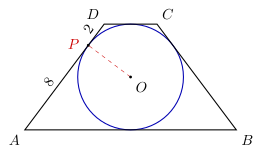
Isosceles trapezoid ABCD around a circle with centre O, tangent to AD at P, with AP = 8 and PD = 2.

Question 4. Given that

\[ x + \frac{1}{x} = 3. \]

a) Find $x^2 + \frac{1}{x^2}$.

b) Find $x^3 + \frac{1}{x^3}$.

c) Find $x^5 + \frac{1}{x^5}$.

Question 5.

a) In how many ways can a person put on a matching sock and shoe on each foot (left and right), given that on each foot the sock must be put on before the shoe?

b) Spiffy the Spider has 8 legs, each of a different colour. For each leg, he has one sock and one shoe of the matching colour. In how many ways can he put on all his socks and shoes if, on each leg, the sock must be put on before the shoe?

Question 6. Solve the system of equations in real numbers:

\[ \begin{cases} x + y + xy = 7 \\ x^2 + y^2 + xy = 13 \end{cases} \]

Question 7. A pedestrian left point $A$ for point $B$. Two hours later, a cyclist left $A$ after him, and another $30$ minutes later, a motorcyclist left $A$. All three moved uniformly without stopping. At some moment after the motorcyclist's departure, it turned out that by that time all three had covered the same fraction of the route from $A$ to $B$.

a) On the coordinate plane $(t; s)$, where $t$ is time (in hours) and $s$ is the fraction of the route completed, draw the graphs of the pedestrian, cyclist, and motorcyclist. Let $t = 0$ correspond to the moment the pedestrian left $A$.

b) Hence, or otherwise, find how many minutes earlier than the pedestrian the cyclist arrived at $B$, given that the pedestrian arrived at $B$ one hour later than the motorcyclist.

Question 8.

a) Find the value of the parameter $a$ such that the equation

\[ ax^3 - 2x^2 - 5x + 6 = 0 \]

has a root equal to $-2$.

b) For the value of $a$ found in part (a), find all roots of the equation.

Question 9. The integers from $1$ to $10$ are written on a blackboard. In one move, one may erase any two numbers $a$ and $b$, and replace them with their difference $|a - b|$. The process continues until only one number remains.

a) Determine whether the sum of all numbers on the board changes parity after each move.

b) What is the least possible value of the final remaining number?

Question 10. Two fixed points $A$ and $B$ and a point $M$ are given in the plane.

a) Introduce a Cartesian coordinate system such that points $A$ and $B$ have coordinates $(-a, 0)$ and $(a, 0)$ respectively ($a > 0$), and point $M$ has coordinates $(x, y)$. Find the lengths of the segments $AM$ and $BM$ in terms of $x$, $y$, and $a$.

b) Find the relation between the coordinates $(x, y)$ of point $M$ if

\[ AM = k \cdot BM, \]

where $k > 0$ is a given constant.

c) Determine the locus of all such points $M$ (consider the cases $k = 1$ and $k \neq 1$ separately).

Math Written Exam for the 3-year program

Question 1.

a) Is $2^{2026}-1$ a prime number?

b) Prove that if $2^n-1$ (where $n$ is a positive integer) is prime, then $n$ is prime.

c) Is the converse statement true?

Question 2. Solve the system of equations:

\[ \begin{cases} x^2 - xy + y^2 = 7, \\ x^4 + x^2y^2 + y^4 = 133. \end{cases} \]

Question 3. On the sides of a triangle of area $1$, squares are constructed externally, and their outer vertices are connected by red segments as shown in the figure.
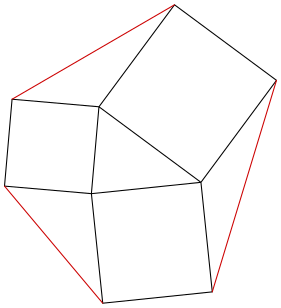
Three squares constructed externally on a triangle, with red segments joining adjacent outer vertices of the squares.

Prove that the three red segments can form a triangle of area $3$.

Question 4. Consider the expression

\[ x^2y + xy^2 + x^2z + xz^2 + y^2z + yz^2 + 2xyz. \]

a) Prove that if $x = -y$, then the expression equals $0$.

b) Hence, or otherwise, factor completely the expression.

Question 5. Three boys, who have one bicycle, need to reach a camp in the shortest possible time. All three of them start at the same time, and since there is only room for two on the bicycle, the third boy must first walk. The cyclist drives one of his friends for a while, then that friend continues on foot, and the cyclist returns to the third boy and they all arrive at the camp at the same moment. Find the average speed of the three boys, given that all of them walk at the same speed of $4 \text{ km/h}$, and the bicycle speed is $20 \text{ km/h}$.

Question 6. For which values of the parameter $a$ does the solution set of the inequality

\[ (x - a)^2(x - 2)(x + 3) \le 0 \]

form a closed interval?

Question 7. In the grid shown below (with some missing edges), how many paths are there from $A$ to $B$ using only steps one unit up or one unit to the right, given that a path cannot traverse a missing edge?
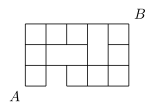
Grid from A at (0,0) to B at (5,3), missing edges (1,0)–(2,0), (3,2)–(4,2), and (2,1)–(2,2).

Question 8. Solve the equation:

\[ x^3 + x^2 + x = -\frac{1}{3}. \]

Question 9. A group of psychologists has developed a test that assigns each person who takes it a score — a positive integer $Q$ — which serves as an indicator of their intellectual abilities (the higher the $Q$, the greater the abilities). The rating of a country is defined as the arithmetic mean of the $Q$ scores of all its residents.

a) A group of citizens from country $A$ emigrated to country $B$. Could the ratings of both countries have increased as a result?

b) Following this, a group of citizens from country $B$ (which may include former emigrants from $A$) emigrated to country $A$. Is it possible that the ratings of both countries increased again?

c) A group of citizens from country $A$ emigrated to country $B$, and after it a group of citizens from country $B$ emigrated to country $C$. As a result, the ratings of each country became higher than their initial values. After this, the direction of the migration flows reversed: some residents from $C$ moved to $B$, and after it some residents from $B$ moved to $A$. It turned out that as a result, the ratings of all countries increased again (compared to their values after the first migration wave but before the start of the second). Is this possible (if yes, provide an example; if no, explain why)? Assume that during the time under consideration, the $Q$ scores of the citizens remained constant, and no one was born or died.

Question 10. For a point $P$ and a circle $\omega$ with centre $Q$ and radius $r$, define the number $\Pi_\omega$ as follows.

If $P$ is not on $\omega$, draw a line through $P$ that intersects $\omega$ at points $A$ and $B$. Then set

\[ \Pi_\omega = PA \cdot PB, \]

where the value is taken positive when $P$ is outside the circle and negative when $P$ is inside. If $P$ lies on $\omega$, we set $\Pi_\omega = 0$.

a) Prove that for any point $P$ and any circle $\omega$ with centre $Q$ and radius $r$,

\[ \Pi_\omega = PQ^2 - r^2. \]

Now consider two non-concentric circles: $\omega_1$ with centre $O$ and radius $R$, and $\omega_2$ with centre $O'$ and radius $R'$.

b) Introduce a coordinate system with origin at $O$, $x$-axis along $OO'$. Let $O(0;0)$, $O'(d;0)$, where $d = OO' > 0$. For a point $P(x;y)$, write down the expressions for $PO^2$ and $PO'^2$.

c) Using the result of part (a), write the equation of the locus of points $P$ for which $\Pi_{\omega_1} = \Pi_{\omega_2}$. Simplify this equation and express the coordinate $x$ in terms of $R$, $R'$, and $d$.

d) Prove that the locus of points $P$ satisfying $\Pi_{\omega_1} = \Pi_{\omega_2}$ is a straight line perpendicular to the line of centres $OO'$.